
261 Broad Street
Windsor, CT 06095
(860) 285-0172
support@invisiblegold.com
Your Website Should Be Easy to Edit
Windsor, CT 06095
(860) 285-0172
support@invisiblegold.com
Your Website Should Be Easy to Edit
System Architecture
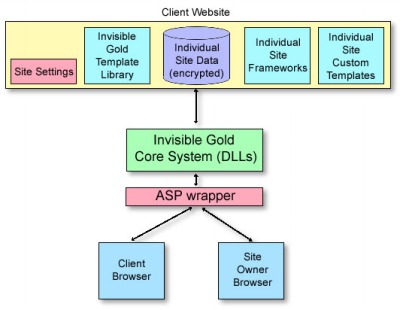
Inside the system there are four areas that can be configured. First there is the data in the pages itself. Each page the public can see has a corresponding page (or pages) in the database. These are edited entirely with a web browser. Second, there are one or more frameworks. These are html files along with corresponding CSS and image files. They define how a section of a website (or the whole site) looks. Each file has special tags that are replaced by content from the database. For example a basic template would have a list of pages on a navigation bar along with content in the main area. It doesn't matter if there are just a few or hundreds of pages in a site. They can all use the same framework. Likewise, one site can have multiple frameworks so different areas have a different look and feel. Third, there are templates. The system has a library of at least 20 templates that define the look and behavior for specific pages. For example: the calendar page behaves very differently than a discussion list page. These are both templates. A site can also have custom templates. The most common types are custom feedback forms and custom registration forms. The one drawback to custom templates is that they need to be manually updated when replacing the core system files for a site. Finally, there is the settings file. This contains system information preferences, the site license, etc. |
See Also:
Keywords:
| Hosting |
Invisible Gold, LLC was founded in 2001 as a web design and internet software company. The owner, John Waiveris, wanted to enable people to manage their own websites. John is active in the Windsor community and the Invisible Gold website software is used daily by 600 businesses.
Latest News
- Website Performance TestingTwo tools for testing website speed
- Meta Tags vs. Keywords: Your Site's Visibility
- Don't Get Tricked By "Domain Registry of America"The Domain Registry of America has recently sent out a countless number of letters and emails in a campaign to get you to switch to their domain registry service by using language that suggests that your domain will expire, and that in order to prevent losing it, you must register with their company. The email is disingenuous at best and fraud at its worst.
Contact Us
Windsor, CT 06095
(860) 285-0172
support@invisiblegold.com
Your Website Should Be Easy to Edit
2026 © All Rights Reserved. Terms of Service